
Quick Answer: Yes, shockwave therapy can treat frozen shoulder in many cases without surgery. It uses focused acoustic waves to break down scar tissue, stimulate blood flow, and trigger the body's own repair process in the shoulder capsule. Most Clients complete a short series of sessions at Evexia and begin noticing improved range of motion …
Quick Answer: Yes, shockwave therapy can treat frozen shoulder in many cases without surgery. It uses focused acoustic waves to break down scar tissue, stimulate blood flow, and trigger the body’s own repair process in the shoulder capsule. Most Clients complete a short series of sessions at Evexia and begin noticing improved range of motion within a few weeks, with the option to combine treatment with a broader root cause evaluation through StemWave.
If you have been living with a shoulder that will not rotate, reach overhead, or let you sleep on that side, you already know how disruptive frozen shoulder can be. Shockwave therapy for frozen shoulder has become one of the most requested non surgical options for people who want relief without the recovery time of an operating room. At Evexia, this treatment is delivered through StemWave, a focused acoustic wave therapy that targets the root cause of joint stiffness rather than simply masking the pain.
Understanding Frozen Shoulder

Frozen shoulder, also called adhesive capsulitis, happens when the connective tissue surrounding the shoulder joint thickens and tightens. This makes the joint capsule stiff, which limits movement and often causes a deep, aching pain that gets worse at night. It typically develops in three overlapping stages, and understanding where you are in that process matters for choosing the right treatment.
Common contributing factors include:
- Prolonged immobility after an injury, surgery, or illness
- Underlying metabolic conditions such as thyroid disorders or diabetes
- Repetitive strain or overuse without adequate recovery
- Age and hormonal shifts, since frozen shoulder is more common in adults over 40
- Inflammation that goes unaddressed at the tissue level rather than just the joint
Many Clients are told to simply wait it out, since frozen shoulder can resolve on its own over one to three years. That timeline is not realistic for most people who need their shoulder for work, sleep, and daily life now, which is why a targeted, non surgical option like shockwave therapy has become so appealing.
It also helps to understand the three stages clinicians commonly describe, since your stage affects how you respond to treatment. The freezing stage brings gradually worsening pain and a slow loss of motion. The frozen stage is when pain may ease somewhat, but stiffness peaks and daily tasks like reaching for a seatbelt or fastening a bra become genuinely difficult. The thawing stage is when motion slowly returns, sometimes over many months. Shockwave therapy can be introduced at multiple points in this progression, though Clients often see the most noticeable gains when treatment starts during the frozen or early thawing stage, once acute inflammation has settled and the tissue is ready to respond to stimulation.
How Evexia’s StemWave Approach Addresses It
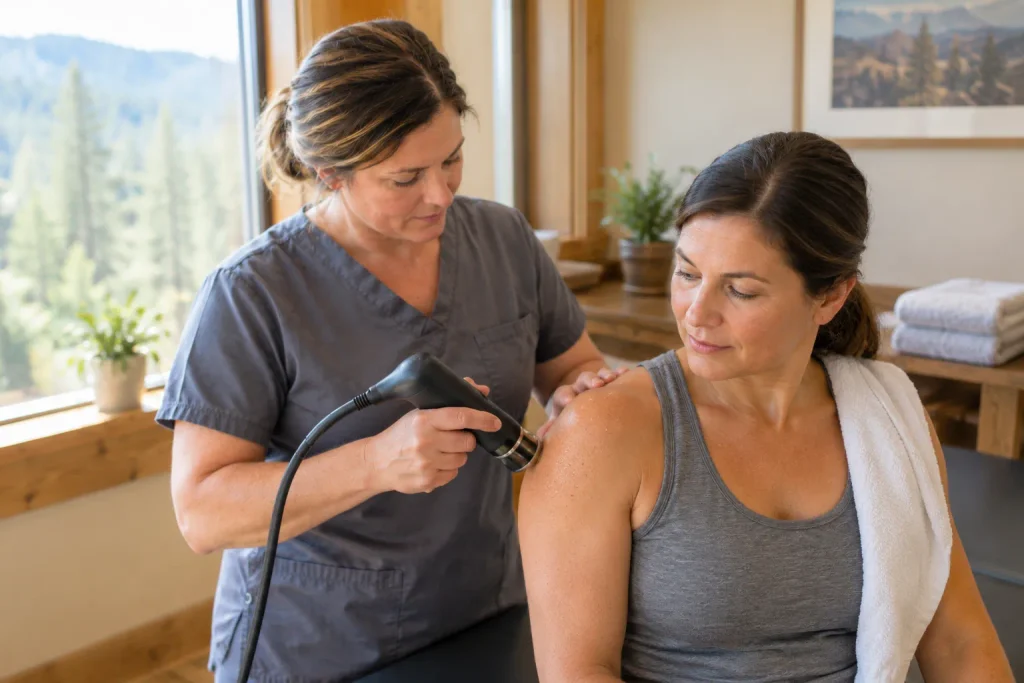
StemWave is Evexia’s focused acoustic wave therapy, and it works differently than rest, ice, or a cortisone injection alone. Instead of temporarily numbing the area, the acoustic waves are directed into the tightened capsule and surrounding soft tissue to encourage the body to repair itself at a cellular level.
Here is what happens during a typical course of care:
- Deanna McNulty or Shawn McNulty, Evexia’s StemWave Treatment Specialist, evaluates your shoulder’s range of motion, pain pattern, and history to confirm frozen shoulder is the correct diagnosis.
- Focused acoustic waves are applied directly over the affected shoulder capsule and any related trigger points in the surrounding muscles.
- The waves stimulate microcirculation, which increases blood flow and nutrient delivery to tissue that has become thickened and under nourished.
- This process is designed to help break down restrictive scar tissue and encourage the production of new, healthier collagen in the joint capsule.
- Most Clients return for a short series of sessions, spaced roughly a week apart, so the tissue has time to respond between treatments.
Because StemWave addresses the tissue itself rather than only quieting the pain signal, it fits Evexia’s broader root cause philosophy. A stiff shoulder is treated as a sign that the tissue needs support to heal, not just a symptom to suppress.
What to Expect: Process, Timeline, and Results

Every shoulder is different, and your provider will tailor the number of sessions to your specific stage of frozen shoulder and how your tissue responds. That said, most Clients follow a similar general arc.
Stage | What You Typically Notice | Approximate Timing |
| Initial sessions | Reduced night pain, mild increase in comfort during daily movement | First 1 to 2 weeks |
| Mid course | Noticeable gains in range of motion, easier reaching and rotation | Weeks 2 to 4 |
| Later sessions | Continued loosening of the capsule, more consistent comfort | Weeks 4 to 6 |
| Maintenance | Ongoing stretching and monitoring to protect the gains made | Ongoing, as needed |
Shockwave therapy is generally well tolerated. Some Clients feel mild soreness for a day or two after a session, similar to a deep tissue massage, but there is no incision, no anesthesia, and no extended downtime. Most people return to normal activity the same day.
Why Choose Shockwave Over Surgery
Surgery for frozen shoulder, whether manipulation under anesthesia or arthroscopic capsular release, carries real risks and a demanding recovery. It also does not address why the capsule tightened in the first place. Shockwave therapy offers a different path for many Clients:
- No incisions, anesthesia, or hospital stay required
- Minimal downtime, so you can keep working and moving through daily life
- Targets the underlying tissue changes rather than just releasing the joint by force
- Can be paired with a broader evaluation of hormonal, metabolic, or inflammatory factors that may be contributing to slow healing
Surgery is still sometimes necessary for severe or long standing cases that have not responded to conservative care. But for many Clients, a non surgical option is worth trying first, especially one built around helping the body repair itself.
It is also worth considering the recovery timeline each option demands. Arthroscopic capsular release typically requires weeks of structured physical therapy afterward just to regain the motion the surgery created, along with time off work and restrictions on lifting or overhead activity. Shockwave therapy sessions, by comparison, are usually done on a lunch break, and most Clients keep working, sleeping, and moving through their week with only mild, short lived soreness. For someone balancing a job, family responsibilities, and a shoulder that already limits daily function, that difference in disruption is often just as important as the clinical outcome itself.
Why Evexia
Evexia was founded on the belief that pain and stiffness are signals, not just problems to silence. Deanna McNulty, DNP, FNP-C, brings more than 26 years in medicine to every treatment plan, and she leads a root cause approach that looks beyond the joint itself. Shawn McNulty, Evexia’s dedicated StemWave Treatment Specialist, works alongside her to deliver focused, individualized shockwave protocols rather than a one size fits all routine.
As a cash pay clinic based in Florissant, Colorado, Evexia is able to spend real time understanding your history, your goals, and what is actually driving your symptoms, whether that is a shoulder that will not move or a broader pattern of inflammation and fatigue. You can learn more about the full StemWave program at Evexia and see how it fits into the clinic’s larger approach to conditions like pain, injury, and recovery.
Frequently Asked Questions
Can shockwave therapy really treat frozen shoulder without surgery?
Yes, for many Clients shockwave therapy is an effective non surgical option. It targets the thickened joint capsule directly to improve blood flow and encourage tissue repair, which often restores range of motion over a series of sessions.
How many shockwave sessions are needed for frozen shoulder?
Most Clients need several sessions spaced about a week apart, though the exact number depends on how long you have had symptoms and how your tissue responds. Your Evexia provider will build a plan around your specific case.
Does shockwave therapy for frozen shoulder hurt?
Sessions can cause mild, brief discomfort as the acoustic waves reach the tightened tissue, and some soreness afterward is normal. There is no anesthesia and no incision, and most Clients tolerate it well.
Is shockwave therapy better than a cortisone shot for frozen shoulder?
Cortisone can reduce inflammation temporarily but does not address the tissue changes causing the stiffness. Shockwave therapy works at the tissue level to support lasting repair, which is why many Clients choose it as a first line, non surgical option.
Who is a good candidate for shockwave therapy on a frozen shoulder?
Most adults with diagnosed adhesive capsulitis who want to avoid surgery are good candidates, especially those in the earlier or middle stages of the condition. An evaluation with your Evexia provider confirms whether it is the right fit for you.
Ready to Move Your Shoulder Freely Again
If shoulder stiffness has been holding you back from sleep, work, or the activities you enjoy, you do not have to wait it out or jump straight to surgery. Book a StemWave session with Evexia and start addressing the root cause of your frozen shoulder today.