
Most health insurance plans, including Medicare and most PPOs, do not cover shockwave therapy for chronic pain conditions because it is coded as elective or experimental rather than medically necessary. This makes shockwave therapy a cash-pay treatment for the vast majority of clients. At Evexia, cash-pay care means a straightforward, physician-guided treatment plan without the …

Most health insurance plans, including Medicare and most PPOs, do not cover shockwave therapy for chronic pain conditions because it is coded as elective or experimental rather than medically necessary. This makes shockwave therapy a cash-pay treatment for the vast majority of clients. At Evexia, cash-pay care means a straightforward, physician-guided treatment plan without the delays or denials that come with prior authorization.
If you have been researching non-surgical options for chronic pain, you have probably asked yourself: is shockwave therapy covered by insurance? For most clients, the honest answer is no, not yet. Shockwave therapy, also known as extracorporeal shockwave therapy, is still classified by most insurance carriers as an elective or investigational treatment. That classification has nothing to do with how effective the therapy is and everything to do with how slowly insurance coding catches up with newer regenerative treatments. Understanding why this gap exists can help you plan for care with clear eyes instead of guessing at what your plan will or will not pay for.
Why Insurance Rarely Covers Shockwave Therapy
Insurance decisions are built around billing codes, and shockwave therapy occupies an awkward space in that system. A treatment can be safe, well-studied, and genuinely effective, and still sit outside what a payer defines as medically necessary.
A few reasons this happens again and again:
- Many carriers still label extracorporeal shockwave therapy as experimental or investigational, even though it has years of clinical research behind it for tendon and joint conditions.
- CPT codes for shockwave therapy exist, but reimbursement policies vary so widely by carrier and by state that consistent coverage never took hold.
- Medicare generally excludes shockwave therapy for musculoskeletal pain, and private insurers tend to follow Medicare’s lead on newer regenerative modalities.
- Coverage is more common when shockwave therapy is bundled into a hospital-based procedure, which is rarely how independent wellness clinics deliver it.
- Prior authorization requirements for pain treatments have grown stricter industry-wide, pushing many effective therapies toward self-pay models regardless of outcomes data.
None of this means the therapy lacks merit. It means the insurance system has not caught up to where regenerative and cellular therapies already are. The same pattern played out with other now-mainstream treatments years ago, and coverage policy tends to follow evidence slowly rather than in step with it.
What Actually Determines Your Coverage or Cost
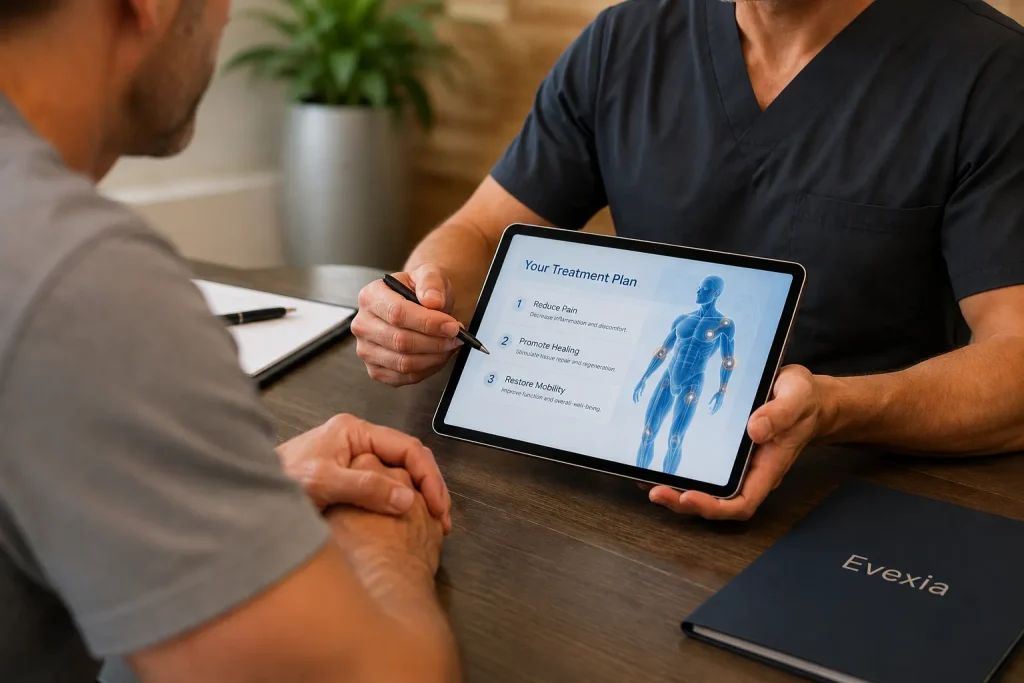
Even within cash-pay care, a few factors shape what your treatment plan looks like and how your provider approaches your case. Rather than guessing, it helps to understand what is actually being evaluated.
| Factor | How It Affects Your Care | What Evexia Does About It |
| Diagnosis and condition severity | Chronic tendon or joint conditions often need a full treatment series, not a single session | A functional assessment defines the right plan for your specific condition |
| Your insurance plan type | HSA and FSA funds can often be applied even when the plan itself will not reimburse | Our team can help you understand what your specific plan allows |
| Prior treatments tried | Documented history of physical therapy or medication use can matter for out-of-network claims | We provide documentation you can submit for potential reimbursement |
| Number of sessions needed | Response to shockwave therapy varies by condition and by individual healing rate | Your plan is built around your body’s response, not a fixed script |
If your plan offers out-of-network reimbursement, Evexia can provide the documentation needed for you to submit a claim on your own behalf, even though the clinic bills directly as cash-pay.
Planning Financially for Cash-Pay Care
Choosing a cash-pay treatment does not mean you have to plan blind. A few practical steps can help you approach shockwave therapy with confidence:
- Check whether your HSA or FSA administrator allows shockwave therapy as a qualified medical expense before your first appointment.
- Ask your employer whether a wellness stipend or supplemental health benefit applies to regenerative or non-surgical pain treatments.
- Request itemized documentation after every visit so you have the option to submit for out-of-network reimbursement later, even if approval is not guaranteed.
- Compare the ongoing cost of unresolved chronic pain, including missed work, repeated physical therapy visits, and potential surgical intervention, against a defined treatment plan built around your specific condition.
- Talk with the Evexia team directly about what a personalized plan involves. Every case is different, and a real conversation gives you far more clarity than guessing from a price list.
Why Cash-Pay Often Means Better Care, Not Just Different Billing
There is an upside to stepping outside the insurance system that many Clients do not expect. Cash-pay care removes the middleman between you and your provider. There is no utilization review deciding how many sessions you are “allowed,” no delay while a prior authorization sits in a queue, and no denial letter interrupting a treatment plan that was already working.
At Evexia, this means your Stem Wave shockwave therapy plan is built around your actual healing timeline, not an insurance formulary. Founder Deanna McNulty, DNP, FNP-C, brings 26 years in medicine to every treatment plan, with a root-cause approach that looks at why the pain developed in the first place rather than only treating the symptom in front of her.
Clients frequently come to Evexia after months, sometimes years, of insurance-approved treatments that only managed symptoms temporarily. A cash-pay model lets your provider design a plan based on your tissue’s actual response to treatment, adjusting session frequency and technique as you heal instead of following a fixed protocol dictated by a claims department that has never examined you.
What to Expect with Cash-Pay Shockwave Therapy at Evexia

- Clients considering Stem Wave often want to know how the process actually works once insurance is out of the equation. Here is the general path:
- Initial consultation. You meet with the Evexia team to review your pain history, prior treatments, and imaging if available.
- Functional assessment. Rather than treating a symptom in isolation, your provider looks for the root mechanical or inflammatory cause behind your pain.
- Personalized treatment plan. Your session schedule is based on your condition and how your tissue responds, not a generic protocol.
- Stem Wave sessions. Acoustic wave pulses are delivered directly to the affected area to stimulate the body’s natural healing and regeneration response.
- Progress check-ins. Your provider tracks improvement and adjusts your plan as your pain and mobility change.
Why Evexia?
Evexia has served the Florissant, Colorado community with functional, root-cause medicine for years, backed by a track record that includes 26 years in medicine and more than 1,800 clients served. Deanna McNulty has been recognized as a 2x Best Physician in Teller County; a distinction built on treating clients as whole people rather than a set of billing codes. Shawn McNulty administers Stem Wave treatments, giving clients a consistent, trained hand throughout their care.
Because Evexia operates as a cash-pay wellness clinic, your treatment plan is designed around clinical judgment first. That is the difference between a system built to move you through quickly and one built to help you heal.
Frequently Asked Questions
Does Medicare cover shockwave therapy?
Medicare generally does not cover shockwave therapy for chronic pain or tendon conditions because it classifies the treatment as investigational. Some clients use supplemental funds or self-pay options instead, and providers can supply documentation for any out-of-network claim you choose to file.
Can I use my HSA or FSA for shockwave therapy?
In many cases, yes. HSA and FSA funds can typically be used for shockwave therapy since it is a recognized medical treatment, even when your standard insurance plan will not reimburse the cost. Confirm eligibility with your plan administrator before booking.
Why is shockwave therapy considered elective by insurers?
Insurers classify treatments based on established billing codes and long-standing precedent, and shockwave therapy is newer to widespread clinical use than many older interventions. This administrative lag, not a lack of evidence, is usually the real reason coverage is limited.
Will my provider give me documentation for an insurance claim?
Yes. Evexia can provide itemized documentation of your visits and treatment that you can submit to your insurer for potential out-of-network reimbursement, even though the clinic itself bills as cash-pay.
Is shockwave therapy worth it if insurance will not pay?
Many clients find that avoiding prior authorization delays, denial letters, and session limits allows for more consistent, effective care. A functional assessment can help you understand whether shockwave therapy fits your specific condition before you commit to a plan.
Ready to Explore Shockwave Therapy Without the Insurance Runaround?
Book your consultation with Evexia and get a treatment plan built around your body, not a billing code.